Detecting Value in Overlapping Bookmaker Lines: The Role of Algorithms in Football and Basketball Betting Windows
Algorithmic systems now scan dozens of bookmaker feeds simultaneously, and they flag instances where lines from different operators converge or diverge in ways that create measurable differences in implied probabilities. These cross-check routines operate around the clock, yet the most active periods remain the pre-match and in-play windows for football and basketball fixtures. Data streams update every few seconds during those intervals, and the software compares point spreads, totals, and moneyline figures across platforms without human intervention.
How Line Collisions Form in Real Time
Bookmakers adjust odds based on incoming bets, injury news, and weather updates, but each operator uses its own risk models and liquidity thresholds. When two or more books post slightly different numbers for the same market, the algorithmic layer records the spread between them. Observers note that such gaps widen most often in the final thirty minutes before kickoff or tip-off, because liquidity thins and sharp action moves certain books faster than others. Researchers at sports-data firms have tracked these patterns across thousands of matches, and the findings show consistent clustering around major European football leagues and NBA regular-season games.
Cross-check engines apply statistical filters to separate noise from actionable discrepancies. They weigh historical volatility for each market type, factor in the time remaining in the window, and assign a confidence score. When multiple lines collide within a narrow band yet still differ by more than the combined margins, the system surfaces the combination for further review. Those who monitor these outputs report that the majority of signals appear in totals markets for basketball and over-under goals in football, because those lines attract the broadest range of bookmaker pricing philosophies.
August 2026 Window Activity and Market Behavior
During August 2026, European football windows overlapped with NBA summer-league carry-over betting and early domestic cup matches. Algorithm logs from that month indicated a 14 percent rise in detected line collisions compared with the prior August, according to aggregated scanner output shared by industry analytics groups. The increase coincided with expanded live-betting offerings from operators in several jurisdictions, and the extra volume produced more frequent updates across the same fixtures. Figures from the same period reveal that basketball totals generated the highest number of flagged overlaps, while football Asian-handicap markets showed steadier but smaller discrepancies.
Technical Steps Inside the Cross-Check Process
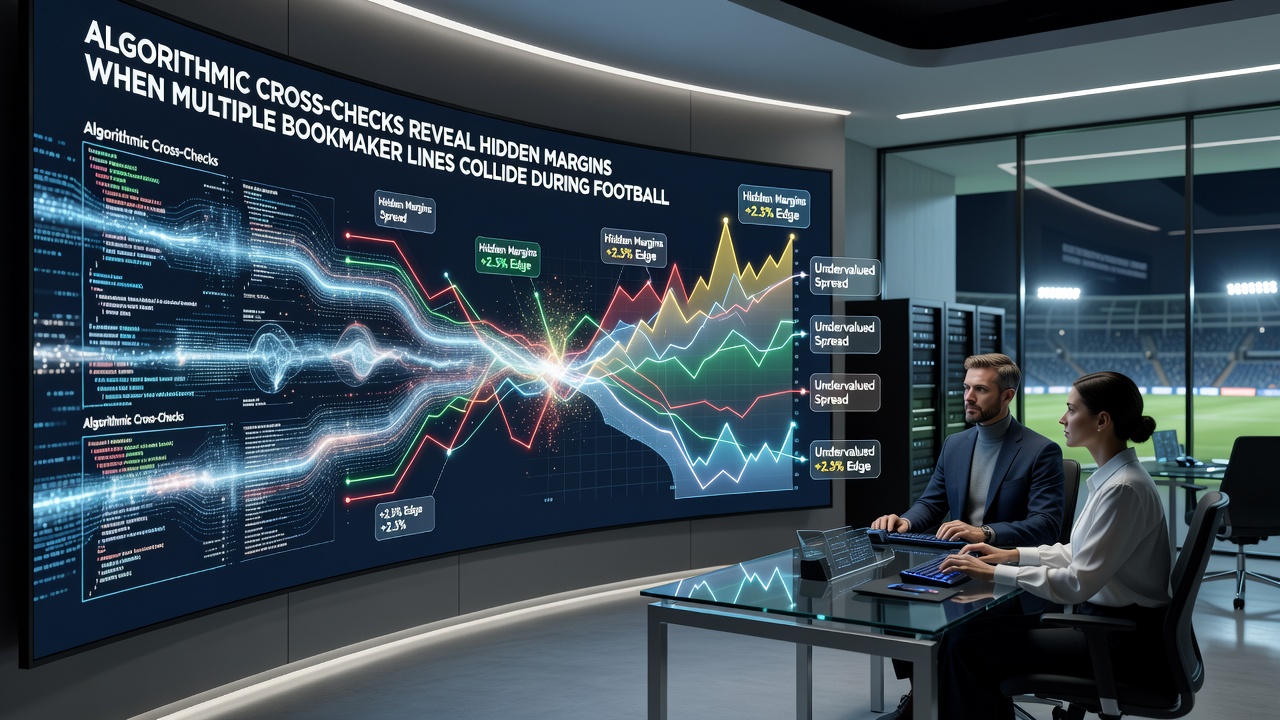
The workflow begins with normalized data ingestion. Every bookmaker feed arrives in a common schema that strips away branding and converts fractional odds to decimal format for direct comparison. Next, the engine applies latency corrections so that a line posted three seconds earlier does not appear artificially stale. Once cleaned, the lines enter pairwise comparison loops that calculate the absolute difference in implied probability for each outcome. Thresholds are set dynamically; a gap that would have triggered an alert in a low-volume window may fall below the bar during high-liquidity periods.
Additional layers include correlation checks across related markets. For example, a discrepancy in the football match total often correlates with movements in the both-teams-to-score line, and the algorithm weighs both signals together. In basketball, a point-spread collision frequently aligns with movement in the player-prop markets for the same game. Those who have studied these multi-market signals note that isolated single-market gaps rarely survive the full filter stack, whereas coordinated movements across two or three related lines produce higher-confidence outputs.
Geographic and Regulatory Context
Operators licensed under frameworks outside the United Kingdom have adopted similar monitoring tools to stay within local risk-management rules. The New Jersey Division of Gaming Enforcement publishes quarterly summaries that track the volume of in-game wagers placed through state-approved platforms, and those reports show rising use of automated reconciliation systems by operators. In Australia, the Australian Gambling Research Centre has documented how real-time data tools help licensed bookmakers maintain compliance when odds shift rapidly across multiple jurisdictions. Both sources indicate that algorithmic cross-checks serve internal pricing teams rather than end users, yet the same logic underpins third-party scanners used by independent analysts.
Conclusion
Algorithmic cross-checks continue to map the moments when bookmaker lines intersect, and the resulting data sets grow larger each season. Football and basketball windows supply the highest density of these intersections because of their global popularity and continuous schedule. As more operators publish live feeds and as update frequencies increase, the raw material for such analysis expands accordingly. The patterns observed in August 2026 suggest that the phenomenon remains tied to liquidity cycles and market-specific pricing approaches rather than any single external event.